Posts

Showing posts with the label Chronic Pain

Impaired sense of comfort: Pain related to Urinary Tract Infection (UTI)

Image
Nursing Care Plan for Urinary Tract Infection (UTI) Urinary Tract Infection (UTI) is a state of bacterial infection in the urinary tract. (Enggram, Barbara, 1998) Signs and Symptoms of Urinary Tract Infection (UTI) Signs and symptoms of UTI: at the bottom are: Pain is often, and a burning sensation when urinating. Spasame the bladder and suprapubic area. Hematuria. Back pain can occur. Signs and symptoms of UTI: at the top are: Fever. Chills. Pelvic pain and waist. Pain when urinating. Malaise. Dizziness. Nausea and vomiting. Impaired sense of comfort: pain related to inflammation and infection of the urethra, bladder and other urinary tract structures. Expected outcomes: Pain is reduced / lost during and after urination. Intervention: 1. Monitor discoloration of urine, urination pattern monitor, input and output every 8 hours and monitor the results of urinalysis reset Rational: to identify indications of progress or deviations from expected results ...

Chronic Pain Management

Image
Chronic Pain Chronic pain is defined as pain that has lasted longer than three to six months, though some theorists and researchers have placed the transition from acute to chronic pain at 12 months. Others apply acute to pain that lasts less than 30 days, chronic to pain of more than six months duration, and subacute to pain that lasts from one to six months. A popular alternative definition of chronic pain, involving no arbitrarily fixed durations is "pain that extends beyond the expected period of healing". Complete and sustained remission of many neuropathies and most idiopathic chronic pain (pain that extends beyond the expected period of healing, or chronic pain that has no known underlying pathology) is rarely achieved, but much can be done to reduce suffering and improve quality of life. Pain management is the branch of medicine employing an interdisciplinary approach to the relief of pain and improvement in the quality of life of those living with pain. The...

Chronic Pain - Nursing Care Plan for Chronic Pericarditis

Image
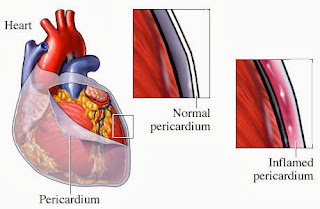
Nursing Care Plan for Chronic Pericarditis Pericarditis is the inflammation of the pericardium. It is caused by infection of the pericardium which is the thin, tough bag-like membrane surrounding the heart. The pericardium also prevents the heart from over expanding when blood volume increases. Symptoms of pericarditis include chest pain, mild fever, weakness, fatigue, coughing, hiccups, and muscle aches. Pericarditis is the inflammation of the pericardium. It is caused by infection of the pericardium which is the thin, tough bag-like membrane surrounding the heart. The pericardium also prevents the heart from over expanding when blood volume increases. Symptoms of pericarditis include chest pain, mild fever, weakness, fatigue, coughing, hiccups, and muscle aches. Chronic pericarditis is long-lasting, gradual inflammation of the pericardium, causing accumulation of fluid in the pericardial space or thickening of the pericardium. The chronic varieties of pericarditis are rare. C...

Nursing Diagnosis for Dermatitis: Pain and Itching related to Skin Lesions

Image
Nursing Diagnosis for Dermatitis: Pain and itching related to skin lesions Nursing Interventions: Independent: 1. Check the area involved Rationale: An understanding of the extent and characteristics of the skin include assistance in planning interventions. 2. Efforts to find the cause of the disorder feel comfortable Rational: Help identify appropriate actions to provide comfort. 3. Record observations in detail by using descriptive terminology. Rationale: An accurate description of skin eruption is necessary for diagnosis and treatment. Many skin conditions look similar but have different etiologies. 4. Anticipating allergic reactions that may occur; getting drug history. Rational: Rash thorough especially with the sudden aeitan may indicate an allergic reaction to the drug. 5. Control factors irritant Rsional: Itching aggravated by heat, chemical, and physical. 6. Maintain humidity of approximately 60%, use a humidifier. Rationale: With low humidity, the skin ...

Pain related to Distention - Nursing Diagnosis for Abdominal Pain

Image
Pain related to Distention - Nursing Diagnosis for Abdominal Pain Abdomen is the part of the body between the thorax and the pelvis, which is separated from the thorax by a diaphragm and from the true pelvis by an imaginary plane. Anteriorly the anterior abdominal wall supports it and posteriorly, the spine and back muscles. Skin, superficial fascia, deep fascia, muscles, layers of fascia (Fascia transversalis), extra peritoneal connective tissue and the outer layer of peritoneum form the anterior abdominal wall. The abdominal cavity extends upwards in to the concavity of diaphragm and downwards in to the pelvic cavity. Since there is overlapping by the ribs in the upper part and pelvic bones in the lower part, the exact size of the abdominal cavity is masked. Abdominal pain can be a sign of a serious condition. Fortunately, minor causes for abdominal pain are much more frequent than major ones. Abdominal pain can come from the esophagus, the stomach, the bowel, the female organs, ...